
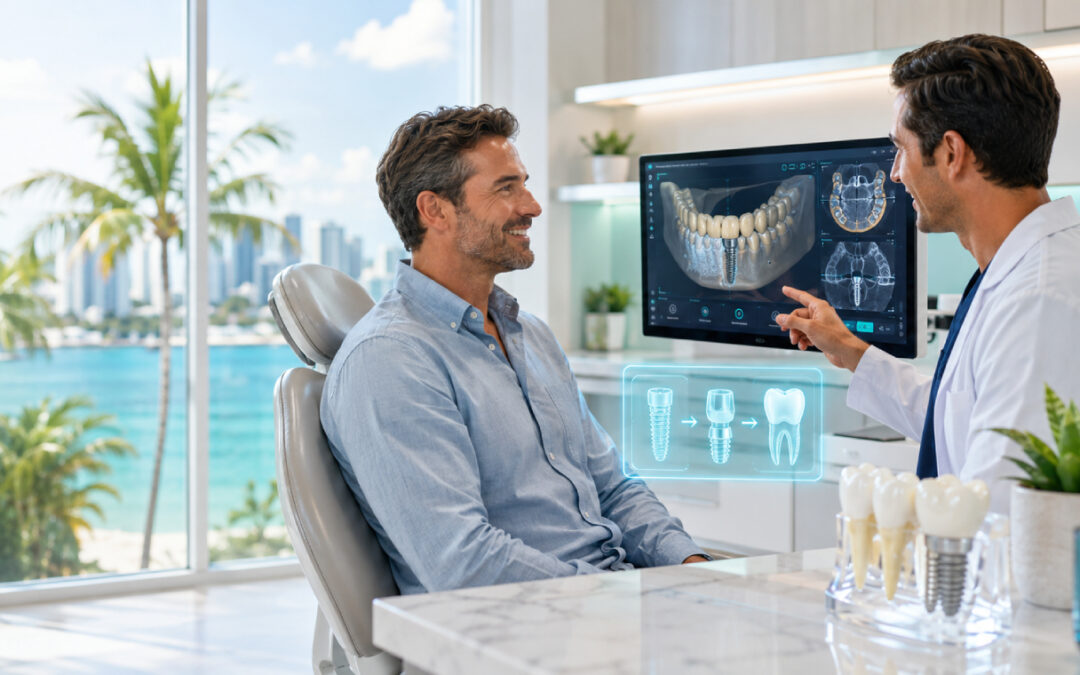
Thinking about dental implants but unsure where to start? You are not alone. Implants can restore chewing, protect your jawbone, and bring back a confident smile, yet most patients have questions about costs, how long treatment takes, and who qualifies.
This guide breaks down the essentials in plain English. You will learn what an implant includes, typical steps from consultation to final crown, average healing timelines, who makes a good candidate, and the most common cost patterns we see across Palm Beach and Broward counties. We will also cover how insurance, HSAs/FSAs, and financing can help.
At Smile Perfection Dental & Orthodontics, we take a comfort-first approach and use digital and 3D imaging to plan precisely and explain each step. If you are ready to see your options, you can schedule a complimentary implant consultation to review images and a personalized plan.
What a modern dental implant includes
A dental implant is a small, biocompatible post that replaces a missing tooth root. It supports a custom restoration to look and function like a natural tooth.
- Implant post: A titanium or zirconia screw placed in the jaw that integrates with bone.
- Abutment: A connector piece that attaches to the healed implant.
- Crown or bridge: The visible part, designed to match nearby teeth in shape and color.
For multiple teeth, two or more implants can support a bridge. For a full arch, four to six implants can support a fixed bridge or an implant-retained denture.
Step-by-step: from consult to final crown
While every plan is individualized, the general sequence is consistent and transparent.
- Consultation and digital imaging
We review your health history, take 3D scans or other digital images, and assess bone volume and gum health. You will see visuals of your options, timelines, and estimated fees. - Site preparation (if needed)
If bone is thin or soft, a bone graft may be recommended to strengthen the site. Minor grafts often add a few months of healing before implant placement. - Implant placement
The implant post is placed in a precise, guided position. Many patients return to normal routines within a day or two with basic aftercare. - Healing and integration
Bone gradually fuses to the implant, a process called osseointegration. Most single-tooth cases heal in about 8 to 16 weeks. Complex or grafted sites can take longer. - Abutment and final restoration
Once stable, we place the abutment and take a digital scan for your custom crown, bridge, or full-arch prosthesis. A carefully matched crown is then attached for a natural look and secure function.
How long it typically takes in South Florida
Timelines vary by health, bone quality, and whether grafting is needed.
- Single-tooth implant to crown: Often 3 to 6 months from placement to final crown.
- Multi-tooth implant bridge: Often 4 to 7 months, sometimes longer with grafting.
- Full-arch solutions: Planning to final restoration can range from 4 to 8 months. Some immediate provisional options are
- possible, but final prosthetics usually follow after healing.
Some patients receive a temporary tooth during healing. Options include a removable flipper, an Essix retainer with a tooth, or a temporary bridge. Your provider will explain what is comfortable and safe for your case.
Typical costs in Florida, and what affects fees
Every treatment plan is unique, so we share ranges to help you budget before you meet with our team.
- Single-tooth implant with abutment and crown: Frequently ranges from the mid $3,000s to the mid $5,000s per tooth, depending on imaging, materials, and grafting needs.
- Multiple adjacent teeth on implants: Per-tooth cost often decreases when teeth are splinted on fewer implants, with total fees varying widely based on the number of implants and the type of bridge.
- Full-arch solutions: Implant-retained overdentures and fixed full-arch bridges can range from the mid-teens to the high $20,000s per arch depending on the number of implants, temporary and final prosthetics, materials, and lab customization.
Key factors that influence price include:
- Diagnostic work: Digital and 3D imaging, planning, and surgical guides.
- Site preparation: Bone grafting or sinus lift when needed.
- Materials and lab: Titanium vs zirconia, abutment type, custom vs stock components, and the lab’s craftsmanship.
- Provisional teeth: Temporary solutions during healing.
- Follow-up and maintenance: Check-ins, adjustments, and hygiene needs.
During your consultation, we review images and provide a clear, line-by-line plan so you know exactly what is included.
Insurance, HSAs/FSAs, and financing
Insurance coverage for implants varies. Many plans classify the implant post as a major service and may offer partial reimbursement, often with annual maximums and waiting periods. Some plans exclude implants but will cover the crown that attaches to an existing implant. Because policies differ, we verify benefits and estimate out-of-pocket costs before treatment.
Health Savings Accounts (HSAs) and Flexible Spending Accounts (FSAs) can usually be applied to eligible implant services. We also offer in-house financing and payment plans to help manage larger cases. Our front-office team will walk you through options before any commitment.
Who makes a good candidate
Most healthy adults qualify for implants. Ideal candidates typically have:
Good overall health and controlled medical conditions.
Healthy gums and adequate bone, or willingness to graft if needed.
Non-smoking status, or a commitment to stop before and after surgery to support healing.
Consistent oral hygiene and preventive care habits.
Who may not be a good candidate? People with uncontrolled diabetes, active periodontal disease, heavy smoking, certain immune conditions, or those unable to maintain oral hygiene may face higher risks. A consultation with digital imaging is the best way to determine candidacy and adjustments that can improve outcomes.
Dentist or oral surgeon, and who places the implant
Both general dentists with advanced implant training and oral and maxillofacial surgeons place implants. What matters most is experience, case selection, digital planning, and coordinated restorative care. Many patients appreciate having the surgical and restorative phases closely coordinated in one office so the final crown or bridge fits precisely and looks natural.
If you are comparing local providers, ask about imaging, surgical guides, the types of restorations they deliver, and how they coordinate temporary and final teeth. For implant treatment and follow-up in Broward County, explore options for dental implants in Pembroke Pines to see how planning and restoration work together.
Pros and potential downsides
Dental implants can protect bone, prevent neighboring teeth from shifting, and feel secure when you chew and speak. Potential downsides include a longer timeline than a traditional bridge, higher upfront cost, the possibility of needing bone grafting, and rare surgical or healing complications. With good planning and home care, most patients do very well and enjoy long-term benefits.
Local care and digital planning
Our team uses digital and 3D imaging to plan placement and restoration, review visuals with you, and explain timelines step by step. We emphasize comfort-first care, gentle anesthetic techniques, and clear aftercare guidance. If you are nearby and comparing options, you can learn more about our Miramar location’s implant planning and restorations to see how imaging supports precise outcomes. If you need urgent attention while researching options, our Pembroke Pines emergency team can help stabilize issues and keep you comfortable until a full plan is ready.
- Learn more about dental implants in Pembroke Pines to explore candidacy and restorations: https://www.smileperfectionortho.com/locations/pembroke-pines/dental-implants
- See implant planning and restorations available in Miramar: https://www.smileperfectionortho.com/locations/miramar/dental-implants
- Need urgent care while considering implants? Visit the emergency dentist page for Pembroke Pines: https://www.smileperfectionortho.com/locations/pembroke-pines/emergency-dentist
Quick FAQ
- How much do dental implants typically cost?
In Florida, a single implant with abutment and crown often ranges from the mid $3,000s to the mid $5,000s. Multi-tooth and full-arch solutions vary more widely. A personalized plan will give the most accurate estimate. - What is the average cost of dental implants in Florida?
Averages vary by region and complexity. Single-tooth totals often fall in the mid $3,000s to mid $5,000s, while full-arch rehabilitations can range from the mid-teens to the high $20,000s per arch depending on materials and lab work. - Does insurance cover dental implants, and how much will insurance pay?
Some plans contribute to part of the treatment, often with annual maximums. Others may cover the crown but not the implant post. Coverage and amounts vary, so benefits verification is essential. - Who is not a good candidate for implants?
Patients with uncontrolled medical conditions, active gum disease, heavy smoking, or an inability to maintain oral hygiene may face higher risks. An evaluation can address many issues to improve candidacy. - How long does the full process take?
Many single-tooth cases finish in about 3 to 6 months. Multi-tooth and full-arch cases can take 4 to 8 months or longer, especially with grafting. - Do you get temporary teeth while waiting?
Yes, many patients use a flipper, Essix retainer, or a temporary bridge during healing. Your provider will recommend the safest option for your case. - Is it better to see a dentist or an oral surgeon for implants?
Both can be appropriate. Experience, digital planning, and restorative coordination matter most. Choose a team that explains imaging, guides, and long-term maintenance clearly. - What is the downside to dental implants?
They typically require a longer timeline and higher upfront cost than a bridge, and may involve grafting or surgical risks. With sound planning and care, most patients achieve excellent long-term function.
Ready to see your personalized plan?
If you live in Palm Beach or Broward County, schedule a complimentary implant consultation. We will review your digital images together, explain options for single-tooth, multi-tooth, or full-arch solutions, outline timelines, and discuss insurance, HSA/FSA use, and in-house financing. You will leave with a clear plan and next steps that match your goals and your budget.