
Missing one tooth can turn into a bigger decision than most people expect. When patients ask about dental bridge vs implant, they are usually not just comparing procedures – they are trying to figure out what will feel natural, last well, fit their budget, and protect their long-term oral health.
Both options can restore your smile and help you chew, speak, and feel more confident again. The right choice depends on your mouth, your timeline, your bone health, and what matters most to you day to day. For some people, a bridge is the most practical answer. For others, an implant is the better long-term investment.
Dental bridge vs implant: the basic difference
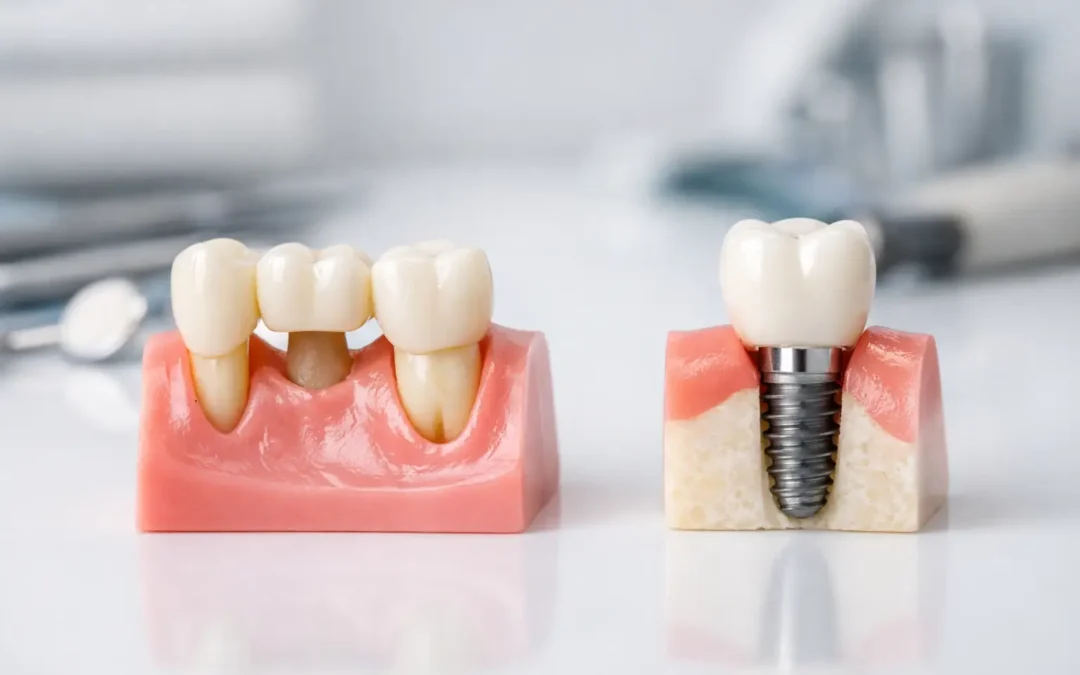
A dental bridge replaces a missing tooth by using the teeth next to the gap for support. In many cases, those neighboring teeth are shaped and covered with crowns, and the replacement tooth sits between them.
A dental implant replaces the missing tooth at the root level. A small titanium post is placed in the jawbone, and after it heals, a crown is attached on top. That means the implant stands on its own rather than relying on nearby teeth.
This difference matters more than it may seem at first. A bridge solves the visible gap efficiently. An implant replaces both the visible part of the tooth and the support underneath it.
When a dental bridge makes sense
A bridge can be an excellent option when the teeth next to the missing tooth already need crowns or large restorations. In that situation, preparing those teeth may be part of the treatment plan anyway, so a bridge can restore the space without adding a surgical step.
Bridges are also often appealing to patients who want a faster solution. In many cases, treatment can be completed more quickly than an implant process because there is no healing period for a post to fuse with the jawbone. If you are hoping to restore your smile on a tighter timeline, that can be a meaningful advantage.
Cost is another reason some patients lean toward a bridge. The upfront fee is often lower than the total cost of implant treatment, especially if extra procedures like bone grafting are needed for the implant.
That said, bridges do come with trade-offs. Because they depend on adjacent teeth, those teeth take on extra responsibility. Even healthy teeth may need to be reshaped, and the area under the bridge requires careful cleaning to avoid gum problems or decay around the supporting crowns.
When an implant is the better fit
An implant is often the preferred option when the neighboring teeth are healthy and do not need crowns. Since the implant does not depend on those teeth for support, it allows them to remain untouched.
Implants also help preserve jawbone. After a tooth is lost, the bone in that area can begin to shrink over time because it no longer receives stimulation from the root. An implant helps maintain that stimulation, which can support both oral health and facial structure.
Many patients also like how natural an implant feels. Because it is anchored in the bone, it can provide a very stable bite and a strong sense of security when eating and speaking. With proper care, implants can last for many years and often outlast other restorative options.
Still, implants are not automatically the right answer for everyone. They require oral surgery, healing time, and enough healthy bone for placement. Some patients are excellent candidates right away, while others may need preparatory treatment first.
Cost matters, but so does the long view
If you are weighing dental bridge vs implant primarily by price, you are not alone. This is one of the most common concerns patients bring to a consultation.
A bridge often costs less upfront. That can make it feel like the easier decision, especially if you want treatment completed soon and need a predictable budget. For many families, immediate affordability is a real factor and should be part of the conversation.
An implant usually costs more at the beginning, but it may offer more long-term value depending on the case. Because it stands independently and can last a very long time with good care, some patients find that the higher initial investment is worth it.
The key is to look beyond the first number. Future maintenance, the condition of neighboring teeth, and the likelihood of replacement down the road all matter. A treatment that looks cheaper now is not always the lower-cost option over time.
Appearance and comfort in daily life
Both bridges and implants can look beautiful when done well. Modern materials are designed to blend naturally with your smile, so the question is usually less about appearance in photos and more about how the restoration functions in everyday life.
A bridge can feel very natural, but because it spans across a space, cleaning underneath it takes special care. Patients need to use specific tools or techniques to keep the area healthy. Once they get used to that routine, many do very well.
An implant often feels closest to having your own tooth again because it is supported individually. Brushing and flossing are usually more straightforward than cleaning around a bridge. That simplicity can be a big plus for patients who want something that fits naturally into their normal hygiene habits.
Comfort is personal, though. Some people prefer avoiding surgery and choose a bridge with confidence. Others prefer the stability of an implant and feel that the longer treatment process is worth it.
Bone health and long-term stability
One of the biggest differences in the bridge versus implant conversation is what happens below the gumline. A bridge restores the crown of the tooth, but it does not replace the missing root. As a result, the jawbone in that area may continue to shrink over time.
An implant helps reduce that bone loss because it functions more like a natural root. This can be especially important for patients who want to protect the shape of their smile and maintain support in the jaw over the years.
That does not mean every patient must choose an implant. It does mean that long-term bone health should be part of the decision, especially for adults who want the most complete form of replacement and are good candidates for treatment.
Who may not be an ideal implant candidate right away
Even if an implant sounds like the better option on paper, timing matters. Some patients have bone loss, untreated gum disease, certain medical concerns, or habits like smoking that can affect healing and success.
In many of these cases, an implant may still be possible, but not immediately. Treatment may need to begin with periodontal care, bone grafting, or a broader plan to improve oral health first. That is why a thorough exam and digital imaging are so important.
A bridge may be the better short-term or practical choice for some patients. It is not a lesser option. It is simply a different one, and for the right person, it can be a very successful treatment.
How dentists help you choose between a bridge and implant
The best recommendation comes from looking at the whole picture, not just the missing tooth. Your dentist will evaluate the condition of the neighboring teeth, your gum health, your bite, your bone support, and your goals.
If the adjacent teeth are heavily restored, a bridge may make excellent sense. If those teeth are healthy and the bone is strong, an implant may offer the best long-term protection. If budget, treatment time, or anxiety about surgery are major concerns, those matter too.
At a practice like Smile Perfection Dental & Orthodontics, this kind of decision is easier when patients can speak with a team that offers comprehensive restorative care, digital imaging, and implant expertise in one place. That allows the treatment plan to be tailored to the person, not forced into a one-size-fits-all answer.
Questions worth asking at your consultation
A good consultation should leave you feeling informed, not pressured. It helps to ask how each option will affect the surrounding teeth, how long treatment will take, what kind of maintenance is involved, and what costs to expect now and later.
You should also ask which option is likely to serve you best five or ten years from now. That question often shifts the conversation from quick fixes to lasting results, which is where the most helpful guidance usually begins.
There is no universal winner in the dental bridge vs implant decision. There is only the option that fits your health, your comfort level, and your priorities best. A thoughtful plan today can make eating, smiling, and caring for your teeth feel easier for years to come.