
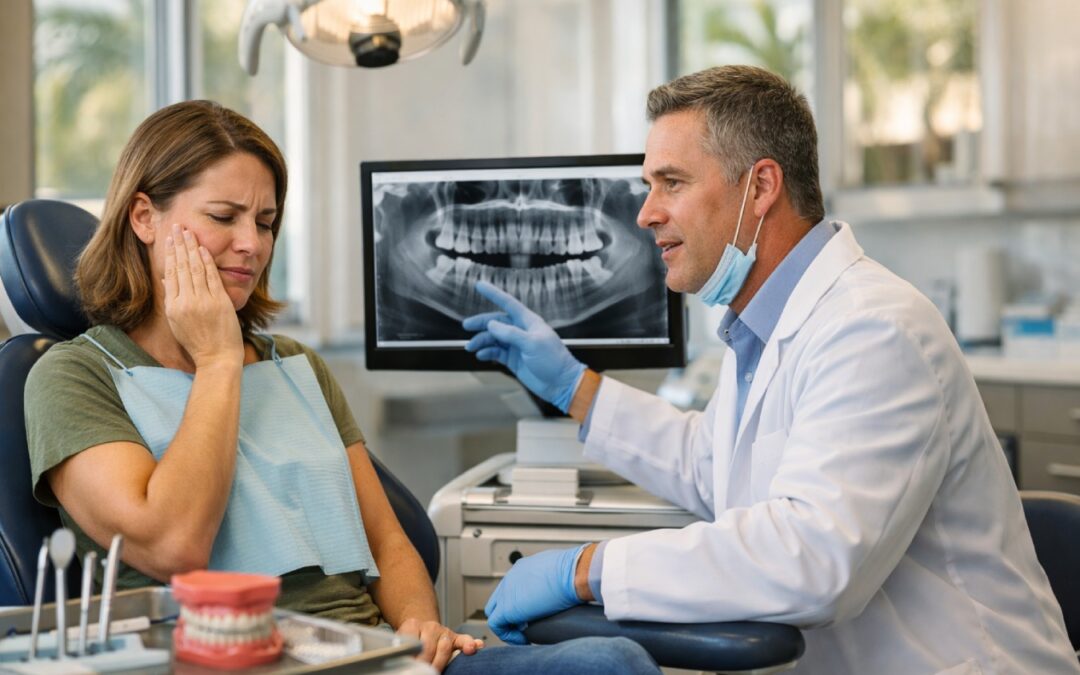
Tooth pain never checks your calendar. It shows up at bedtime, on the sidelines, or right before a big meeting. When it happens, you need clear steps, not guesswork.
This guide explains what really counts as a dental emergency, what you can do at home to stabilize the situation, and when to call a dentist vs heading to the emergency room. You will also find quick tips for pain relief and red flags that mean you should seek care right away.
If you are in pain now, call your nearest Smile Perfection Dental & Orthodontics location. We often hold same- or next-day urgent visits when available, offer bilingual Spanish-English communication, and have Saturday options at select offices.
What qualifies as a dental emergency
Call a dentist promptly if you have any of the following. If life-threatening symptoms are present, call 911.
- Severe toothache that disrupts sleep or daily activities
- Facial swelling, gum swelling, or a pimple-like bump on the gums
- Knocked-out (avulsed) tooth
- Cracked or broken tooth, especially with pain or sharp edges
- Loose or lost crown, bridge, or filling that exposes the tooth
- Trauma to the mouth, heavy bleeding, or a deep cut to the lip, cheek, or tongue
- Orthodontic problems that cause injury, such as a wire piercing the cheek or tongue
- Signs of infection like fever, foul taste, or swelling that is spreading
Mild sensitivity to cold or a small chip without pain can often wait 1 to 2 days, but call to schedule an evaluation so the problem does not worsen.
ER, urgent care, or dentist: how to choose
- Go to the emergency room if you have fever with facial swelling, swelling that affects breathing or swallowing, uncontrolled bleeding, or jaw fracture concerns.
- Choose urgent care if you need help controlling pain, nausea, or minor soft-tissue injuries when a dentist is not immediately available.
- Call a dentist first for toothaches, cracked or broken teeth, lost or loose crowns or fillings, knocked-out or partially dislodged teeth, and orthodontic wire issues.
What will the ER do for a bad tooth? In most cases, ER teams cannot perform definitive dental procedures. They typically provide pain control and may prescribe antibiotics if an infection is suspected, then advise you to see a dentist. Can the ER do anything for your teeth? They can help stabilize you and address serious medical risk, but they usually do not perform root canals, fillings, extractions, or crown repairs.
At-home steps to stabilize common problems
These steps are for short-term stabilization until you can be seen.
Severe toothache
- Rinse gently with warm salt water. Keep food away from the sore tooth.
- Use a cold compress on the cheek for 10 minutes on, 10 minutes off.
- Take over-the-counter pain relief as directed below.
Broken or cracked tooth
- Rinse with warm water. If a piece broke off, store it in milk or saliva and bring it.
- Cover sharp edges with orthodontic wax or sugar-free gum.
- Avoid biting on that side.
Knocked-out permanent tooth
- Pick it up by the crown, not the root. If dirty, gently rinse without scrubbing.
- Try to place it back in the socket, then bite on gauze. If not possible, keep it in milk or in your cheek pouch. Do not store in water.
- Call immediately. Teeth have the best chance of survival when reimplanted within 60 minutes.
Lost crown or filling
- Rinse the crown or tooth. If possible, place the crown back with temporary dental cement from a pharmacy. Do not use glue.
- Avoid sticky or hard foods. Bring the crown to your visit.
Orthodontic wire problems
- Press a poking wire flat with a pencil eraser or cover it with orthodontic wax.
- If a bracket is loose but still attached to the wire, leave it in place and call for an appointment.
Soft-tissue cuts
- Apply gentle pressure with clean gauze for 10 to 15 minutes. Seek urgent care if bleeding does not stop or the cut is deep.
Pain control you can try at home
For most adults without contraindications, alternating ibuprofen and acetaminophen can provide strong relief. A common approach is to take ibuprofen (if your medical history allows) and acetaminophen in staggered doses so one overlaps the other. Always follow label instructions and your physician’s guidance. Which painkiller is best for severe toothache? There is no one best option for everyone, but many dentists recommend using both acetaminophen and an anti-inflammatory like ibuprofen together, as directed, for short-term relief. Avoid aspirin directly on gums or teeth because it can burn tissue. Topical numbing gels can help briefly but wear off quickly.
If tooth pain is unbearable, call a dentist for an urgent evaluation. Severe, throbbing pain can indicate infection or nerve involvement that needs clinical treatment, not just medication.
When to call, and what to expect at our offices
Call a dentist promptly if you have:
- Pain that interferes with sleep, work, or school
- Swelling or fever
- A knocked-out, loose, or fractured tooth
- A lost crown or filling with sensitivity
Our team uses digital imaging for rapid diagnosis, explains options in plain language, and can often provide same- or next-day care when available. Saturday appointments are offered at select locations, and our staff can communicate in English or Spanish. If you are in Broward and searching for an emergency dentist in Pembroke Pines, you can learn more about urgent visit options at our Pembroke Pines page. If you live closer to Miramar, see services at our Miramar dental clinic page. Families in Royal Palm Beach can review local care options at our Royal Palm Beach dentist page.
Red flags that need urgent attention
- Fever with dental pain or swelling
- Facial swelling that is firm, rapidly increasing, or spreading toward the eye, neck, or floor of the mouth
- Difficulty breathing, swallowing, or opening the mouth
- Pus or a foul taste with rising pain
- Trauma with uncontrolled bleeding or suspected broken jaw
Call 911 or go to the ER for any breathing or swallowing concern.
What dentists can and cannot do in an emergency visit
Will they pull a tooth, emergency dentist? If a tooth cannot be saved and extraction is appropriate, a dentist may perform it or provide a referral. However, whenever possible, the goal is to save the tooth with treatments like a filling, crown, or root canal. Can you go to urgent care for dental emergencies? Urgent care can help with pain control and rule out broader medical issues, but they typically cannot complete dental procedures. A dentist provides definitive treatment, such as repairing a broken tooth, securing a loose crown, draining an abscess when indicated, or starting a root canal.
Quick FAQ
What qualifies as a dental emergency? Severe toothache, swelling, trauma, knocked-out or broken teeth, lost restorations with pain, orthodontic wires causing injury, and any signs of infection such as fever or spreading swelling.
What will the ER do for a bad tooth? Usually stabilize pain, address serious infection risk, and prescribe medications. They rarely perform dental procedures and will advise you to see a dentist.
Can the ER do anything for your teeth? Yes, for medical stabilization and pain control. No, for most dental treatments like fillings, root canals, or crown repairs.
Will an emergency dentist pull a tooth? If saving the tooth is not feasible, extraction may be recommended. Dentists first assess whether a restoration or root canal could preserve it.
What to do if tooth pain is unbearable? Call a dentist immediately. Use cold compresses and short-term over-the-counter pain relievers as directed. Do not place aspirin on the tooth or gums.
Which painkiller is best for severe toothache? Many patients get relief with a combination of acetaminophen and ibuprofen when safe, taken as directed. Consult your physician if you have medical conditions, are pregnant, or take blood thinners.
Can you go to urgent care for dental emergencies? You can for pain control or evaluation if a dentist is unavailable. For definitive treatment, contact a dental office.
Your next step
If you or your child is in pain, do not wait. Save our number, then call for a same-day evaluation when available. We will walk you through immediate at-home steps, arrange prompt care, and communicate in the language you prefer. If you are near Pembroke Pines, Boynton Beach, Royal Palm Beach, or Miramar, start with the emergency visit page for the location closest to you. Relief often starts with the first call.